![sendify-helpcenter-logo-white-2.svg]](https://help.sendify.com/hubfs/sendify-helpcenter-logo-white-2.svg)
⏱ 5 minutes to read
Dangerous goods are not permitted for transport through Sendify unless "Dangerous goods" is selected during the booking process. Read more about this further down.
Please note that this guide only provides an overview of the rules for limited quantities. For full terms and detailed requirements, please refer to the Swedish Civil Contingencies Agency (MSB): MSB – Limited quantity.
Shipping dangerous goods with Sendify
Dangerous goods include substances and articles that may pose a risk to health, safety, property, or the environment. Their transport is regulated by both international and national rules depending on the mode of transport, with the aim of minimizing accidents and damage. To ship dangerous goods with Sendify, you need to be a Sendify-designated approved sender.
Rules and requirements when transporting dangerous goods
To ensure safe and lawful transport, the sender must provide correct documentation and details. This includes proper packaging, marking, labeling, and documentation according to the regulations for the different modes of transport:
- ADR (Road transport) — read more here
- IMDG (Sea transport, only via Sendify Freight)
- RID (Rail transport)
- IATA (Air transport, only via Sendify Freight)
The regulations can vary depending on the mode of transport. For example, stricter requirements apply to air transport, such as pressure-differential tests for liquids and specific declarations.
Can I ship dangerous goods with Sendify?
If the goods are classified as dangerous goods in limited quantities, they can be shipped via Sendify. DHL, FedEx, and Ntex handle this type of goods, and by clicking "Limited quantity dangerous goods" at booking, the carrier is informed that the shipment contains dangerous goods in limited quantities. Fully regulated dangerous goods must be booked using "Dangerous Goods" in Sendify.
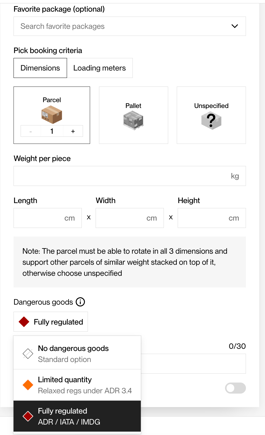
To ship dangerous goods with Sendify, you must be an approved sender. To become one, go into "Settings" - "Account" - "Form Field Options" and select "Submit interest".
The sender is responsible for ensuring that:
- A goods declaration in accordance with the applicable regulations is included.
- The packaging is correct and meets the requirements.
- The shipment is marked and labeled according to the regulations.
Please note that DHL does not allow return shipments of dangerous goods from private individuals. However, you can ship to private individuals — you just cannot receive returns.
Both NTEX and DHL Freight support domestic transport of dangerous goods. Full terms for these services can be found on each carrier's website.
What are Limited Quantity Dangerous Goods?
Limited quantity is a transport rule that applies to certain types of dangerous goods, where packaging methods grant special benefits and exemptions from stricter requirements.
Examples of products that can be classified as dangerous goods in limited quantities
- Aerosol cans (e.g. hairspray, deodorant, spray paint)
- Paint and varnish (paints, solvents, lacquers)
- Perfumes and fragrances (flammable substances)
- Cleaning agents (corrosive or flammable chemicals)
- Batteries (small lithium batteries, not UN3480 or UN3090)
- Nail polish and remover (flammable solvents)
- Lighter gas and lighter fluid (flammable gases or liquids)
- Chemical kits (for home or laboratory use)
What is Limited Quantity?
Limited quantity is a transport rule that applies to certain types of dangerous goods, where packaging methods grant special benefits and exemptions from stricter requirements. DHL and other transport companies can transport goods in limited quantities as long as they meet the applicable regulations. The rules are uniform for road and sea transport, with the exception that sea transport requires a goods declaration.
Requirements for Transporting Limited Quantities
To be able to ship dangerous goods as a limited quantity, several criteria must be met:
1. Training according to Chapter 1.3
All parties who handle dangerous goods in limited quantities — including senders, recipients, carriers, loaders, unloaders, and packers — must have completed training according to Chapter 1.3 of the regulations. However, no safety adviser is required for the operation.
2. Quantity limits per inner packaging
Each substance has a specified quantity limit per inner packaging, set out in tables in the dangerous goods regulations. Certain substances, such as the most hazardous and unsuitable ones, cannot be transported under this rule.
3. Packaging requirements
- Goods must be packed in high-quality combination packaging.
- An inner packaging must be placed inside an outer packaging.
- The packaging normally does not need to be type-approved, but it must meet the construction requirements set out in the regulations.
(image)
4. Weight limits
- The maximum permitted gross weight for a combination packaging is 30 kg.
- Trays with stretch film or shrink film may have a maximum weight of 20 kg.
- These are the only approved methods for transporting limited quantities.
(image)
5. Correct marking of packages
- Each outer packaging or tray must be clearly marked with the limited quantity symbol.
- If the package contains liquid, the outer packaging and any overpack must be fitted with orientation arrows (this way up).
(image)
- Batteries (small lithium batteries, not UN3480 or UN3090) See specific terms for UPS and FedEx here
Summary
Transporting dangerous goods as a limited quantity brings certain benefits, but there are strict rules to follow. It is always the sender's responsibility to have the correct knowledge and competence as required by law. This guide provides a basic overview, but for full compliance you must ensure that you understand and follow the applicable regulations.
Read more about Limited Quantity at MSB.
When transporting dangerous goods, delivery time may be affected, and the estimated delivery time may change during transit.
Need more help?
If you have questions about transporting dangerous goods or need further support, we recommend contacting expert support. You can also contact Sendify's support for help.
💡 Do you have more questions about dangerous goods in limited quantities? Contact our support and we'll help you!